
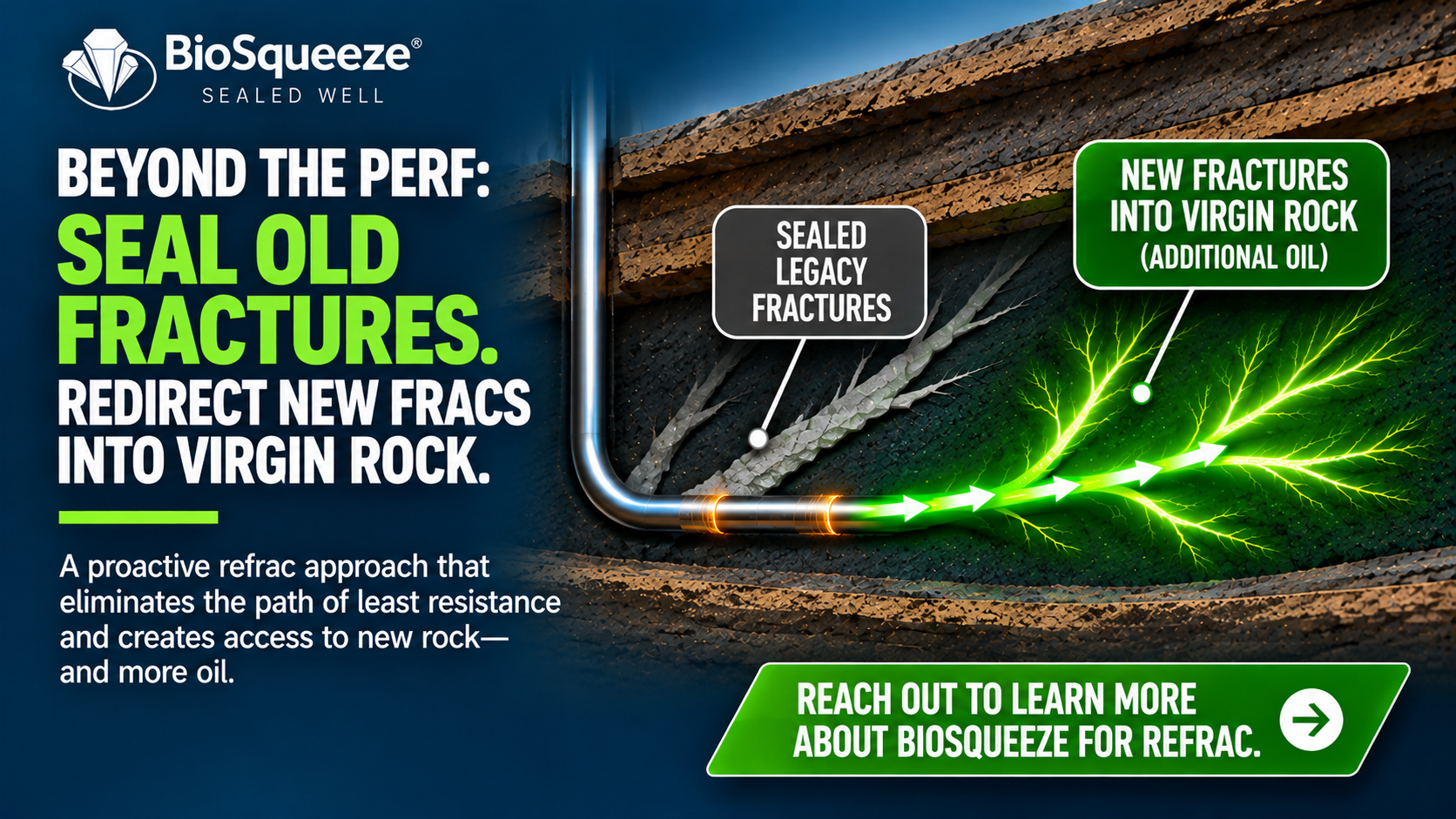
A refrac should do more than pump into an old well: it should reach rock the first completion left behind. Yet the original fracture network remains in place. When the next treatment arrives, those established pathways can offer an easier route than breaking into undrained rock. New perforations alone do not guarantee new reservoir contact.
Liners, mechanical isolation, optimized perforations and temporary diverters can help control where a treatment enters the wellbore. But the original fractures may still be available farther into the formation. BioSqueeze is developing a more direct answer to that problem: seal selected old fractures so the next stimulation is encouraged to create new fractures into virgin rock.
The refrac problem: old fractures are still the easy path
When a horizontal well is initially completed, hydraulic fracturing creates conductive pathways between the wellbore and surrounding reservoir. Over time, production changes reservoir pressure and the local stress field. Some fractures continue contributing production, while others connect to depleted regions or compete with new stimulation pathways.
A refrac may follow the path of least resistance into those established fractures, recycling stimulation into previously contacted rock rather than creating access to virgin reservoir. Even new perforations can reconnect with old networks after the treatment leaves the wellbore.
The opportunity is to change the pathway itself—not just move the entry point. Seal the old routes that steal the treatment, then direct the next frac toward rock with remaining oil and gas.
The BioSqueeze concept: seal old fractures before the next frac
BioSqueeze’s established well-integrity technology uses low-viscosity treatment fluids and an in-situ biomineralization process to form calcium carbonate within connected leakage pathways. As mineral accumulates, permeability decreases and unwanted fluid movement can be restricted.
For refracturing, the concept is to place biomineralization treatment in selected legacy fractures and seal those flow paths before pumping the next stimulation. Instead of merely moving the perforation, the goal is to take away the old fracture network’s preferential route.
With selected legacy fractures sealed, the next treatment may be forced to initiate or extend new fractures into previously uncontacted, potentially productive rock. That is the central differentiation: seal the old fractures to redirect new fracs.
Conventional techniques can control wellbore access or temporarily divert fluid, but may leave the legacy fracture network open beyond the entry point. BioSqueeze aims to change that subsurface condition itself by sealing selected existing fractures before the refrac.
This is a proposed refrac application, not a demonstrated field outcome. Its success depends on selectively placing a durable seal, preventing bypass or reconnection, and proving that the redirected stimulation reaches productive rock.
How sealing old fractures stacks up against existing refrac methods
Cemented liners and mechanical isolation
Cemented liners allow operators to isolate the original completion and establish new perforation locations. This provides greater control over where stimulation enters the formation, but it adds installation and intervention costs and reduces usable wellbore diameter.
Mechanical isolation can also restrict access to selected intervals. However, neither method necessarily prevents fractures initiated at new perforations from reconnecting with conductive legacy networks farther into the reservoir.
A liner can move the entry point, but it does not necessarily close the old fracture network. BioSqueeze’s proposed differentiator is to seal selected legacy pathways in the rock itself, potentially giving a new perforation a better chance to stimulate new reservoir.
Temporary chemical and particulate diversion
Temporary diverters are commonly used to restrict dominant flow paths during stimulation. Particles, fibers and other engineered materials can help redistribute treatment fluid toward alternative clusters or fracture pathways.
Many diversion systems are designed to degrade or lose their plugging effectiveness after treatment, although cleanup and restored conductivity depend on the specific chemistry and conditions.
Temporary diverters can shift treatment distribution, but many are designed to degrade after stimulation. BioSqueeze instead proposes a persistent seal in selected old fractures: remove the easier route and encourage the next frac to grow into virgin rock. The tradeoff is that sealing a productive old fracture could also remove valuable production.
The question is not whether a seal sounds stronger than a diverter. It is whether sealing the right old fractures produces more incremental recovery than the best conventional refrac strategy, after accounting for cost and any lost legacy production.
Optimized perforation placement
Advanced reservoir and fracture modeling allows operators to evaluate new cluster locations relative to original fracture spacing, depletion patterns and remaining productive rock.
A recent Delaware Basin case described by Devon and ResFrac demonstrated the potential value of this approach. The selected optimized refrac design forecast a 41% estimated ultimate recovery uplift compared with approximately 31% for an earlier design at the same modeled cost. Early production supported the modeled trend, although ultimate recovery remained a forecast rather than a measured lifetime result.
This is the bar BioSqueeze must clear. Optimized perforation placement already adds value in some wells. Selective fracture sealing must demonstrate that closing old pathways adds value beyond simply choosing better entry points.
Where sealing the old path could unlock new rock
Not every refrac candidate would benefit from sealing existing fractures. Some wells may have insufficient remaining productive rock, while others may already achieve effective placement through conventional isolation or diversion.
The strongest candidates may be wells with identifiable undrained rock but dominant legacy fractures that could draw the next treatment away from it. In those wells, sealing the old route could help redirect fracture growth toward new reservoir contact.
The concept is deliberately assertive: seal selected old fractures, remove the path of least resistance, and redirect new fracs into virgin rock. Whether the rock actually fractures that way must be established by modeling, diagnostics and field results.
A successful application would need to balance several objectives. The treatment must reach the intended fracture network, establish sufficient hydraulic restriction, withstand subsequent stimulation conditions and preserve enough existing productive connectivity to deliver a net economic benefit.
The target is selective sealing, not shutting down every old fracture. Productive legacy pathways may need to remain open, and the design must account for bypass, reconnection and the potential loss of existing production.
What must be demonstrated before field application
BioSqueeze’s experience with biomineralization provides a technical foundation, but applying the process to refracturing introduces different performance requirements.
Laboratory testing must establish whether mineralized fractures can maintain hydraulic restriction under representative closure stress, differential pressure, temperature and stimulation-fluid exposure. Testing must also evaluate how effectively treatment fluids penetrate and distribute within propped and unpropped fracture pathways.
Integrated reservoir and hydraulic-fracture modeling would then help determine whether those measured properties could meaningfully change stimulation placement.
A practical evaluation should compare an optimized refrac alone, an optimized refrac with conventional diversion and the same design incorporating selective BioSqueeze pretreatment.
The comparison must account for additional productive rock contacted, potential loss of legacy fracture contribution, treatment cost and any changes in production timing.
Laboratory sealing performance alone would not establish commercial refrac value. Controlled field evaluation and production monitoring would ultimately be needed to demonstrate whether the approach creates incremental recovery.
Beyond the perf: change the path, not just the entry point
Refracturing has evolved from simply restimulating an existing well toward more deliberate control of treatment placement. Operators now have better tools for selecting candidates, optimizing perforations, isolating intervals and modeling fracture growth.
BioSqueeze’s proposed refrac application goes beyond choosing new perforations. It aims to seal selected old fractures so the next treatment no longer defaults to the same established pathways.
That is the differentiation: conventional methods may move or temporarily restrict fluid entry, while the old fracture network can remain an attractive path. BioSqueeze proposes sealing that path before restimulation to encourage new fractures into virgin rock.
Whether selective biomineralization can provide that advantage will depend on treatment placement, seal durability, fracture-network response and measurable incremental recovery.
Seal the old fractures. Redirect the new fracs. Reach rock the first treatment left behind. That is the opportunity BioSqueeze is working to validate.
Interested in a new approach to refracturing? Reach out to BioSqueeze to learn how our proposed fracture-sealing technology could help redirect stimulation into previously untouched rock and unlock additional recovery from existing wells. Visit BioSqueeze.com to connect with our team.