Strengthen
Cement grains and particles at their contact points to increase bearing capacity and stabilize unconsolidated materials.

Platform & technology
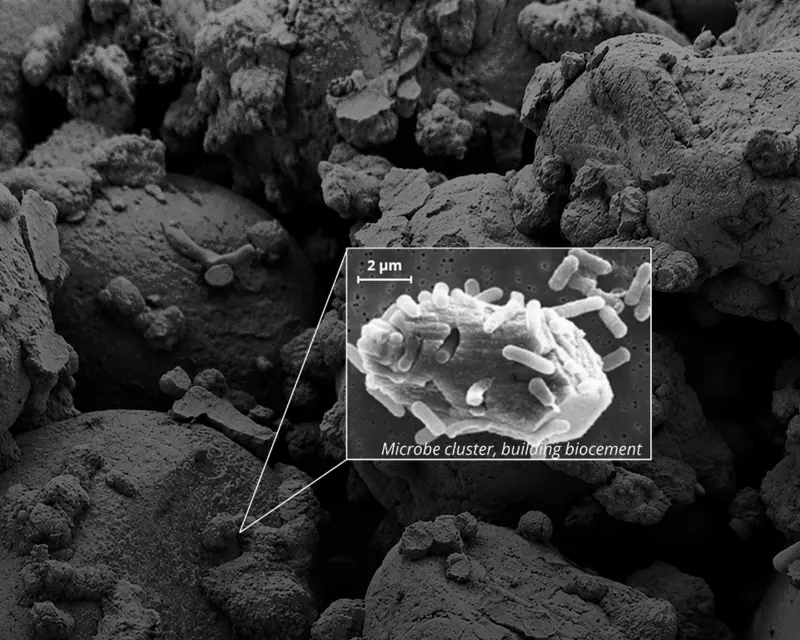
Low-viscosity fluids move through pores, fractures and void spaces, then form structural limestone precisely where it is needed.
Biology becomes infrastructure
Cement grains and particles at their contact points to increase bearing capacity and stabilize unconsolidated materials.
Reduce permeability within connected fluid pathways and create a permanent mineral barrier.
Fill fractures, reinforce damaged cement and restore continuity within aging infrastructure.
Advantages of BioSqueeze
Six practical characteristics explain why biomineralization can address defects and connected pathways that are difficult for conventional bulk materials to reach.
At approximately the viscosity of water, BioSqueeze fluids enter micro-annuli, pores, fractures and channels that bulk materials cannot access.
Treatment is designed to mineralize within the intended connected pathway or treatment zone while preserving surrounding open geometry.
The fluids follow the highest-permeability pathway first. As mineral forms and permeability falls, treatment redirects into the next connected pathway.
Calcium carbonate precipitates in direct contact with rock, steel, cement and aggregate rather than arriving as a pre-formed material.
The process uses controlled oxygen. When it is consumed, biological activity stops and the microbes become entombed in the mineral they produced.
The result is inert crystalline limestone—not an ongoing biological reaction or a temporary organic barrier.
From science to engineering
Biomineralization occurs throughout nature. The engineering challenge is making it predictable, repeatable and practical under real field conditions.
BioSqueeze has developed the fluid systems, manufacturing controls, pumping equipment, treatment designs and operating procedures required to deploy biomineralization as an engineered subsurface process.
Introduce low-viscosity treatment fluids through existing access points or purpose-built injection systems.
Follow connected pores, fractures and pathways that cement, grout and other bulk materials often cannot reach.
Use a controlled metabolic process to precipitate calcium carbonate and create structural limestone in place.
Why the process works
In complex connected systems, the most conductive pathway takes fluid first. Mineral formation progressively reduces that pathway's permeability, naturally redirecting treatment into the next pathway.