
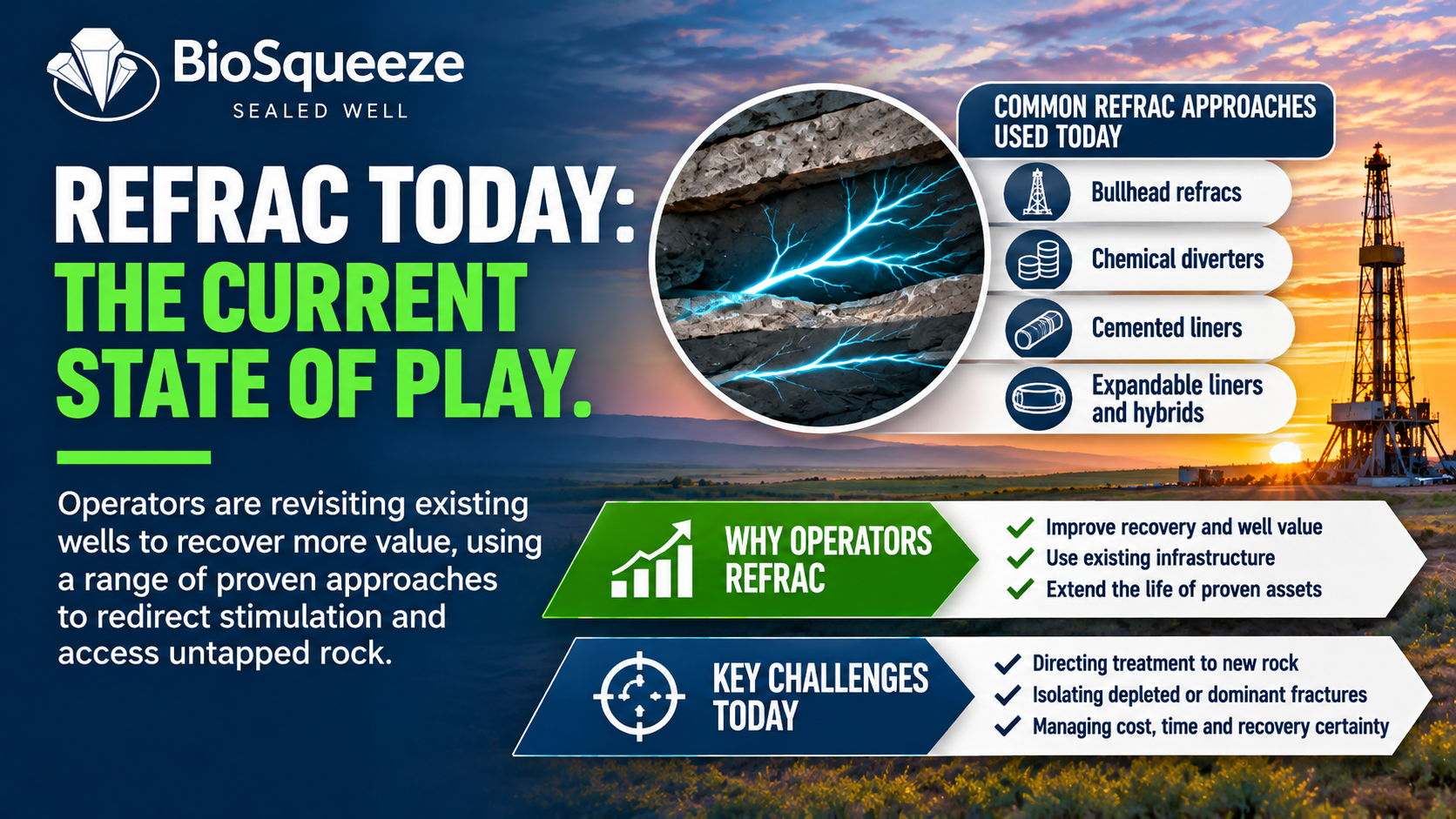
Refracturing has moved from an occasional second chance for an aging well to a deliberate redevelopment option in selected unconventional portfolios. Rather than automatically drilling another lateral, operators are asking whether an existing well can be stimulated again to contact productive rock left behind by its original completion. The opportunity is real, but it is far from universal: economics depend on the well, the remaining reservoir and the ability to place the next treatment where it can do useful work.
The current market is not defined by one dominant refrac recipe. Operators use relatively simple bullhead treatments, temporary diversion, new cemented liners, expandable systems and selective combinations of these tools. Each approach makes a different trade between cost, operational complexity, wellbore access and control over where stimulation fluid enters.
Why operators are revisiting existing wells
Many older shale wells were completed before today’s tighter cluster spacing, improved fracture modeling and more systematic diagnostics became common. Their production histories can reveal under-stimulated intervals, uneven contribution or remaining rock that may justify another treatment. Existing surface facilities and a drilled lateral can also make redevelopment attractive compared with a new-well project, depending on site conditions and costs.
But production decline alone is not a refrac business case. Depletion changes reservoir pressure and stress. Original fractures may already have drained the most accessible rock; new fluid may preferentially re-enter those pathways. Operators therefore screen for remaining recoverable resource, original completion geometry, mechanical integrity, offset-well effects and expected incremental cash flow—not simply well age.
What the current refrac toolkit looks like
Bullhead refracs: simple access, less placement control
Bullhead refracturing pumps into the existing completion without a new full-length liner. It can limit intervention scope and preserve internal diameter. The tradeoff is that fluid can favor the easiest existing entries, making it difficult to know how much of the treatment reaches previously under-stimulated rock. Operators may choose this route when the economics favor a lower-complexity campaign and the original completion provides acceptable access.
Diversion: changing where fluid goes during the job
Diverted bullhead programs add temporary diverting materials or sequences intended to restrict dominant flow paths and shift fluid toward other entry points. Pressure response and treatment diagnostics help guide execution, but diversion is not the same as permanent stage isolation. Results depend on material placement, fracture geometry, fluid conditions and whether the restriction persists long enough to change treatment allocation.
Cemented liners and plug-and-perf: more deliberate stage control
A new liner can isolate the original perforations and provide a fresh completion surface for perforating selected clusters. Plug-and-perf then gives operators stage-by-stage control over new entry locations. This is a more involved workover with additional material, installation time and potential loss of usable inside diameter. Even with a liner, fractures initiated from new perforations can reconnect with old fracture networks in the reservoir.
Expandable and hybrid designs: tailoring isolation to the well
Expandable liners, localized patches and partial-liner approaches provide alternatives when a full cemented liner is not the preferred fit. Hybrid programs may combine mechanical isolation in selected intervals with diversion elsewhere. The choice depends on casing condition, clearance requirements, original completion layout and the expected value of more selective stimulation. There is no single design that fits every basin or vintage.
Where operators are active—and why the picture varies
Published operator examples illustrate different levels of commitment. In the Eagle Ford, operators have disclosed recurring mechanical-isolation refrac programs and full-liner recompletions. In the Barnett, an operator has publicly described a hybrid approach combining selective bullhead treatments and expandable liners. Other basins—including the Bakken, Permian and Appalachian plays—have candidate inventories, pilots or documented historical work, but the publicly available evidence does not establish a consistent current annual pace or a uniform preferred method for every operator.
That distinction matters: a candidate inventory is not an annual job count, and a successful pilot is not evidence of basin-wide adoption. Current refrac activity is better understood as selective, operator-specific redevelopment than as a single industry-wide rollout.
The technical problem behind every method: placement
The central question is not simply whether a well can be pumped again. It is whether the treatment can contact economically productive rock that the first completion did not adequately drain. Existing perforations, propped fractures and depleted pressure corridors may offer easier routes than new fracture initiation. Better isolation at the wellbore can improve control over entry points, but it cannot erase depletion or guarantee that a fracture will remain separate farther into the reservoir.
A 2026 Devon/ResFrac Delaware Basin case study underscores the value of design before treatment. The authors reported a modeled 41% estimated ultimate recovery uplift for an optimized refrac design, versus approximately 31% for an initial design at the same modeled cost. Early peak-rate results on two wells were close to forecasts, but lifetime recovery remained a projection. The lesson is about the importance of candidate-specific placement—not a universal performance benchmark.
How operators decide whether a refrac pays
The comparison begins with a no-refrac baseline: what would the well produce if left alone? Operators then weigh the cost and expected recovery of an optimized refrac, with or without diversion or added mechanical isolation. The full scope includes well preparation, diagnostics, rig or coiled-tubing time, materials, pumping, flowback, restart and possible production interruption.
Operators also distinguish production acceleration from genuinely additional ultimate recovery. A strong early rate can improve near-term cash flow without necessarily adding the same proportion of lifetime barrels or gas volumes. Uncertainty in commodity prices, offset impacts and reservoir response can change the preferred design even when the technical job is executable.
What defines the state of play today
Three themes emerge. First, refracs are increasingly screened and designed around individual well histories rather than treated as a generic recipe. Second, operators have multiple practical ways to redirect stimulation, but stronger control generally adds execution scope and cost. Third, the hardest uncertainty lies beyond the casing: where new fractures travel relative to old networks and depleted rock.
The next advance in refracturing will be judged by measurable incremental recovery and net value against the best conventional design—not by a treatment concept alone. For now, understanding the methods operators already use, and where those methods reach their limits, is the essential starting point.
In our next article, we will explore emerging ideas for managing existing fracture pathways before a refrac and the evidence needed to evaluate them. This article focuses on the industry’s current toolkit and decisions.