
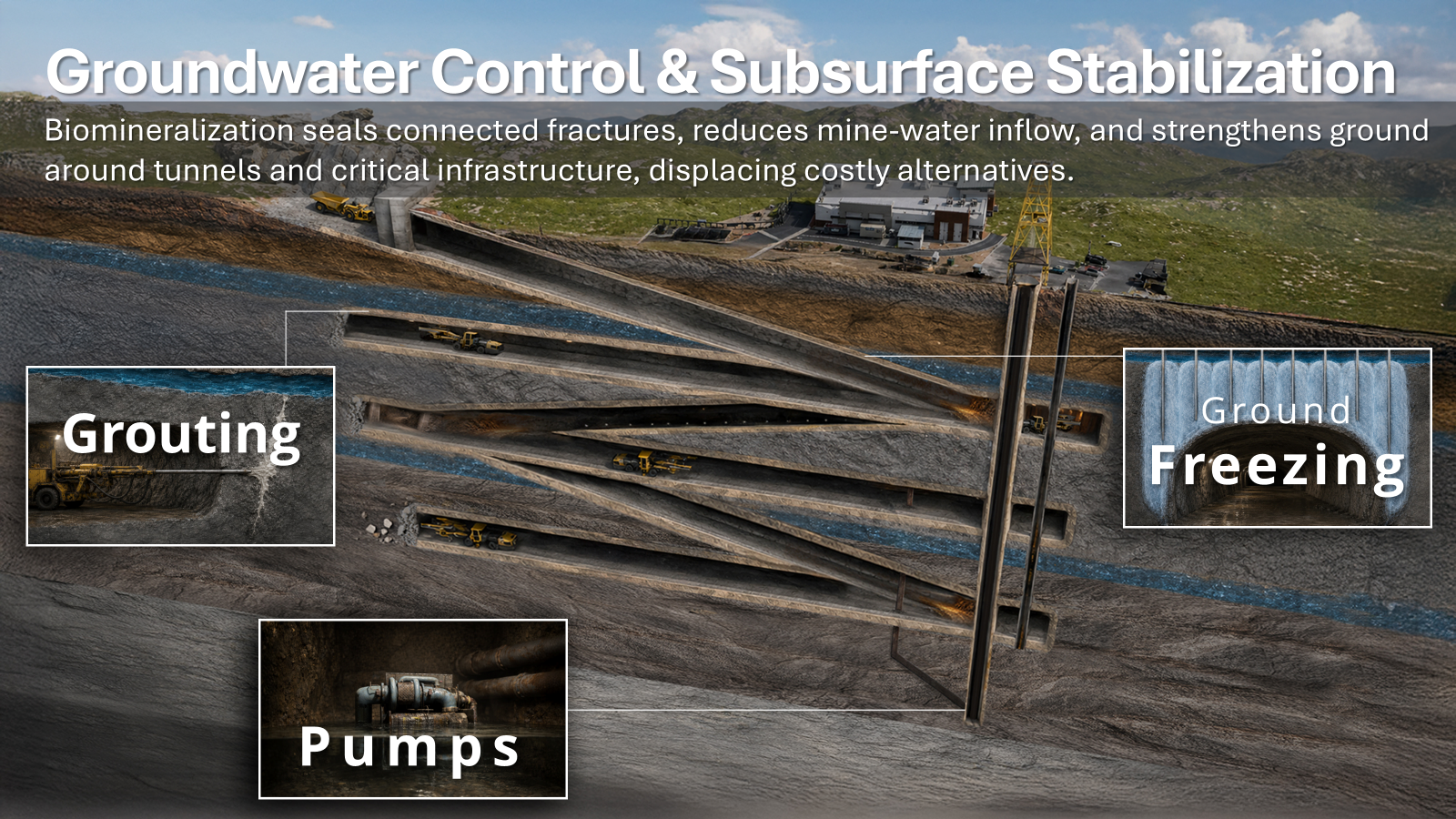
Cutaway illustration of an underground mine showing water pathways, fractures, tunnels and treatment zones

Mining

Control water.
Stabilize materials.
Contain what matters.

BioSqueeze is adapting its biomineralization platform to recurring mining problems where subsurface access, uncertain geology and material movement limit conventional construction.

Strengthennative soils and aggregates
Sealfractures and flow paths
Containimpacted water and materials
Deploythrough low-viscosity fluids

Why biomineralization

Many mining problems are really problems of access and placement.

Mine operators have effective tools for excavation, pumping, grouting and structural support. The challenge becomes harder when water moves through poorly defined fractures, impacted material covers a large area, or the treatment must reach deep into soil or rock without disrupting operations.

BioSqueeze uses water-like treatment fluids to move through the same connected pathways as groundwater. Mineral formation then occurs in place—reducing permeability, cementing particles or reinforcing the treated material.

Priority applications

Start where the platform has a clear engineering job.

The strongest early applications are bounded problems with connected treatment pathways and a measurable performance target.

01

Seal

Mine dewatering

Reduce water inflow by locating and treating connected fractures, permeable formations and preferential flow paths around shafts, tunnels and active workings.

  • Fracture sealing
  • Water-bearing formations
  • Shaft and tunnel inflow
  • Targeted permeability reduction
02

Seal

Acid mine drainage & plume control

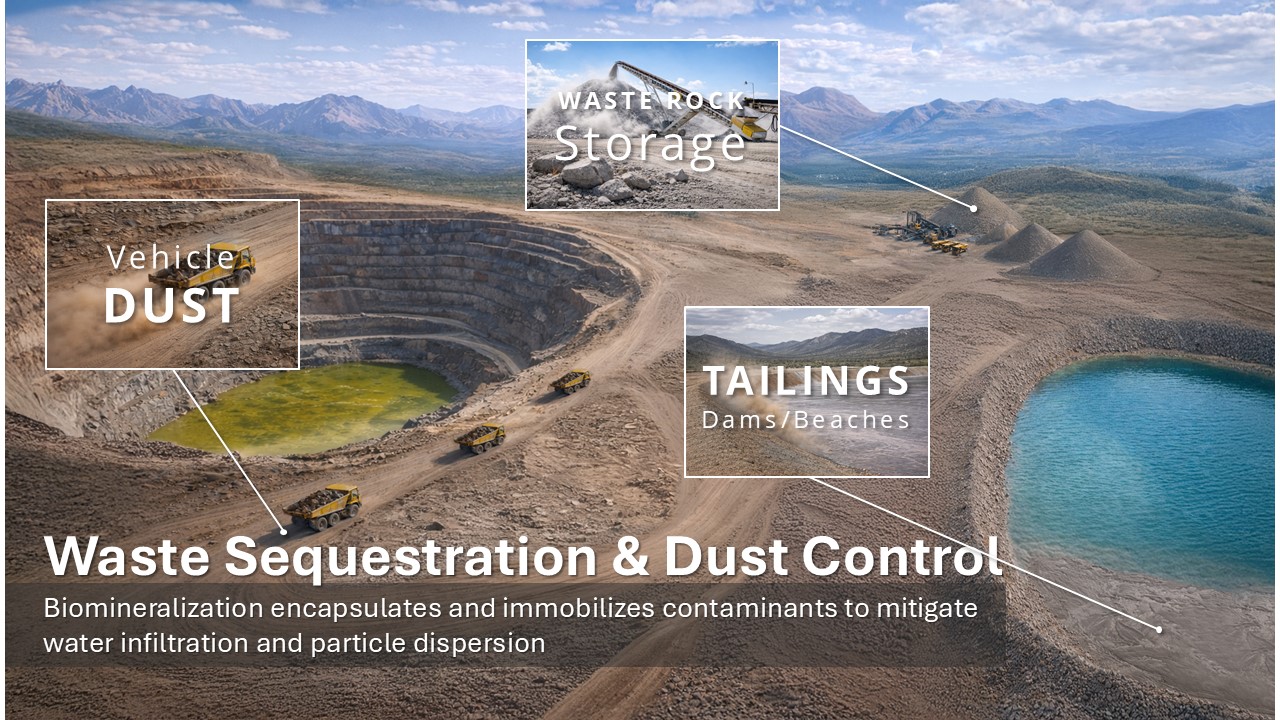
Form mineral barriers in soil and rock to interrupt groundwater pathways, contain impacted water and reduce contact between water and reactive materials.

  • Groundwater barriers
  • Waste-rock containment
  • Reactive zones
  • Plume interception
03

Strengthen · Seal

Tailings & waste rock

Stabilize unconsolidated material, control erosion and create low-permeability mineralized zones without relying solely on excavation or imported bulk materials.

  • Tailings capping
  • Slope and surface stability
  • Erosion control
  • Closure applications
04

Strengthen

Operating surfaces & dust

Bind native aggregate and surface fines to improve haul roads, working surfaces and dust control while reducing the volume of imported cementitious material.

  • Haul roads
  • Dust suppression
  • Portal and pad stabilization
  • Remote operating surfaces

Project fit

Good targets share four characteristics.

Mining geology varies too much for a one-size-fits-all claim. BioSqueeze begins with characterization, bench testing and treatment design.

01

Connected pathways

The fluid must be able to reach the problem through fractures, pores or unconsolidated material.

02

Treatable mineral system

Substrate chemistry, groundwater conditions and treatment geometry must support controlled mineral formation.

03

Measurable objective

The project needs a defined permeability, strength, inflow or containment target that can be verified in the field.

04

Phased deployment

Laboratory characterization and a bounded field trial establish design parameters before full-scale treatment.

Application development

Field discipline transferred from more than 400 commercial deployments.

Mining is an emerging commercial market for BioSqueeze. The platform enters it with established manufacturing, treatment design, field quality systems and deployment experience from Oil & Gas—plus large-scale soil-strengthening work developed through Department of War programs.

The next step is not a broad technology claim. It is a carefully selected field problem with an operating partner, baseline data and a verification plan.

Discuss a mine application

Share the geology, water pathway and operating constraint.