
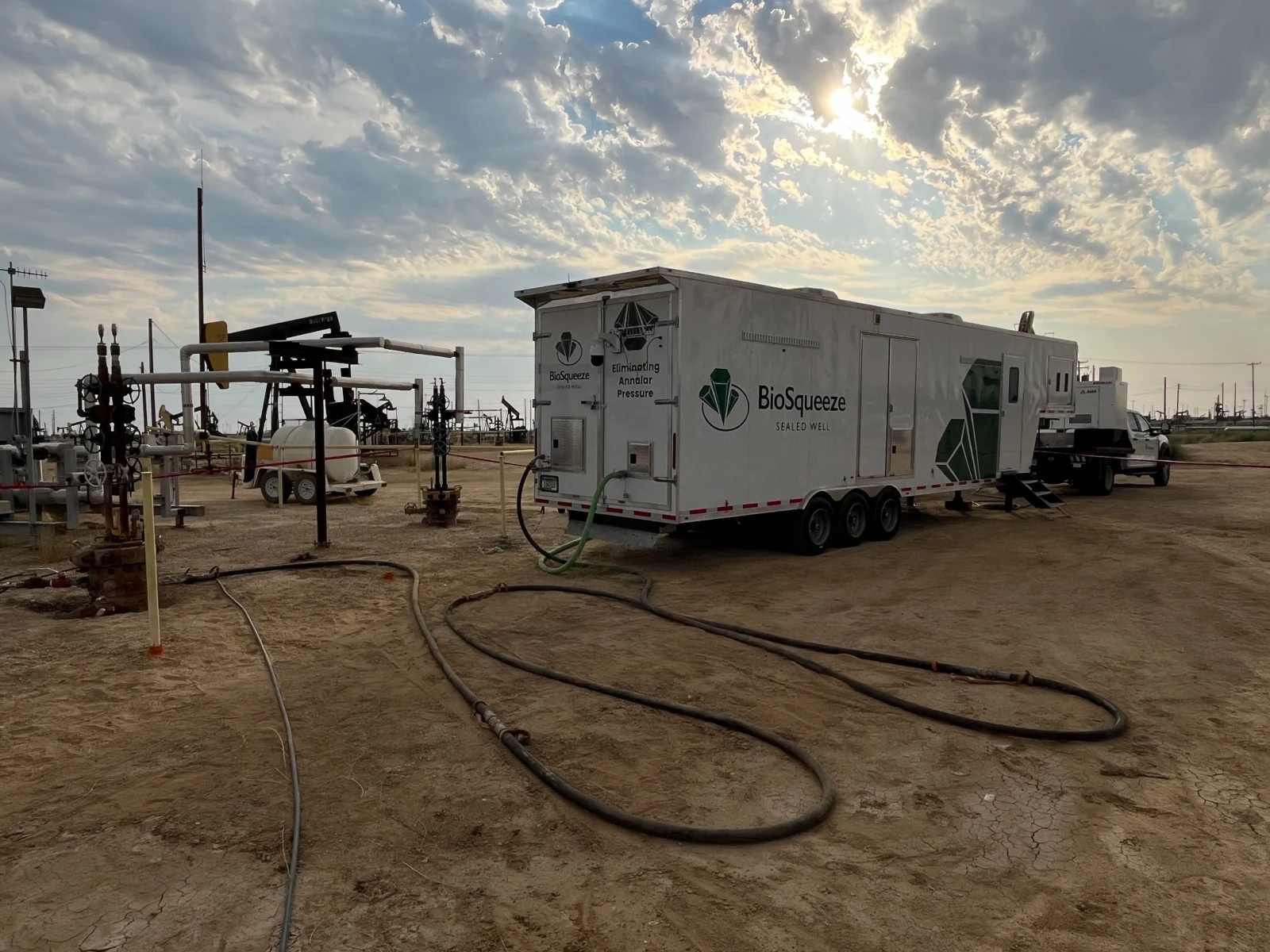
Recognized for restoring mechanical integrity in active wells while preserving full drift and avoiding permanent downhole repair hardware.
BioSqueeze has been named the Small Company winner of the 2026 Interstate Oil and Gas Compact Commission (IOGCC) Chair’s Stewardship Awards for its work restoring mechanical integrity in active wells. The recognized project applies biomineralization to discrete casing leaks, with the objective of restoring pressure containment while preserving the well’s internal diameter.
The recognition connects environmental stewardship with a practical operating challenge: repairing a localized defect in otherwise usable infrastructure. Producing, injection, disposal, and underground storage wells all depend on casing integrity to contain pressure and fluids. A small casing leak can interrupt operations and create the need for additional remedial work.
Repairing the leak while preserving access
A pinhole, corrosion pit, crack, failed connection, or damaged perforation can cause a well to fail a pressure test even when the surrounding casing remains usable. Repair options must account for the defect, well conditions, and the need to maintain access for pumps, tools, future interventions, and eventual plugging.
BioSqueeze places biomineralizing fluids across an identified, isolated leak interval. Their water-like viscosity allows them to follow leakage pathways, where calcium carbonate—the mineral found in limestone—forms in place. As flow through treated pathways decreases, subsequent fluid can move into remaining open pathways.
The approach is designed to seal the defect without leaving a permanent patch or liner inside the casing. Preserving full drift maintains the internal clearance needed for future well operations. Placement can use a workstring, coiled tubing, or a rigless configuration when well conditions allow.
Verification connects the repair to the outcome
The objective is a repair demonstrated by the applicable pressure test or static pressure hold. The award submission describes mechanical integrity treatments that have enabled producing, injection, disposal, and storage wells to return to service, including cases following previous cement, resin, or patch attempts.
Treatment suitability depends on the well’s condition and the ability to identify and isolate the leaking interval. Pressure-test results provide a measurable basis for evaluating whether the repair has restored the required containment.
Environmental stewardship through well integrity
Maintaining containment helps address the risk of gas or fluid moving outside its intended pathway. Restoring existing infrastructure can also reduce the need for repeated workovers, equipment mobilizations, waste handling, and additional personnel exposure associated with further remedial work.
The recognized work extends BioSqueeze’s biomineralization platform from its established use in sustained casing pressure and gas-migration remediation to localized mechanical integrity repairs in active and return-to-service wells.
Ryan Wilson is representing BioSqueeze at the IOGCC Annual Conference in White Sulphur Springs, West Virginia. BioSqueeze thanks IOGCC for the recognition and acknowledges the field teams, customers, and partners involved in advancing the application.
Discuss your mechanical integrity challenges
Contact BioSqueeze to discuss casing leaks, pressure-test failures, and opportunities to restore integrity while preserving wellbore access.