
Energy application
Refrac
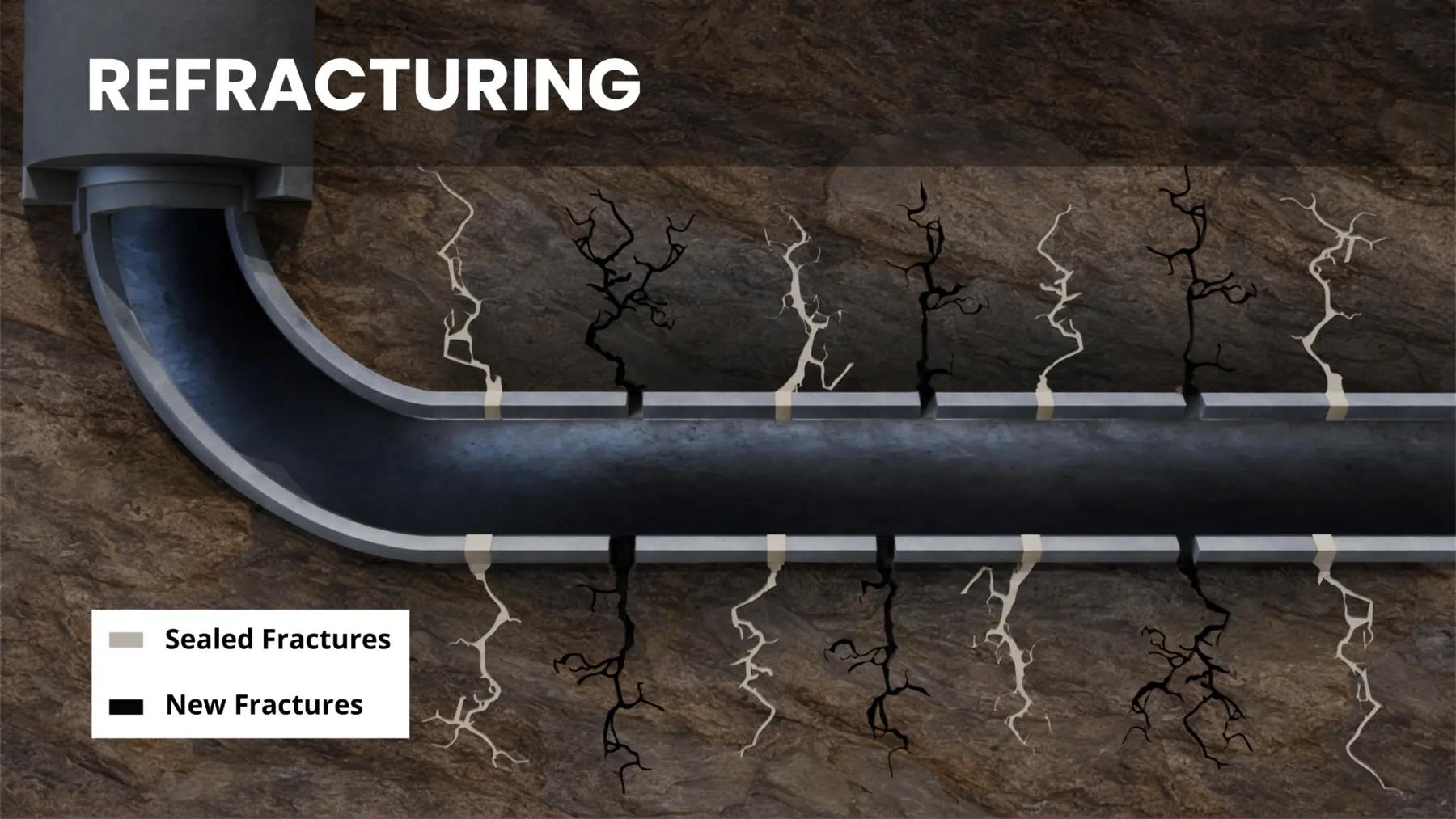
Seal depleted fracture networks so restimulation energy can create new reservoir contact.
Application focus
Seal depleted fractures. Access stranded reserves.
During refracturing, depleted legacy fractures can continue to accept fluid and energy even when the objective is to reach unstimulated rock. Near-wellbore isolation alone may not address the connected fracture volume extending away from the well.
Low-viscosity BioSqueeze fluids are designed to penetrate deep into depleted fractures and form limestone throughout the connected network. Reducing conductivity in those legacy paths gives the subsequent refrac a stronger opportunity to initiate new fractures—without liners or plugs.
Discuss this applicationWhere it fits
Designed around the connected pathway.
Every program begins with the treatment objective, available diagnostics, access geometry, injectivity and the performance signal that will define success.
- Legacy-fracture sealing
- Refracturing isolation
- Linerless refrac
- New reservoir contact
Related articles
The Next Generation of Refracs
The oilfield has spent the last twenty years getting exceptionally good at creating fractures. Longer laterals. More stages. More clusters. Higher proppant concentrations. Faster pump rates. Today’s…
Read article →NETL Oil & Gas Center of Excellence: A New Era in American Energy Innovation
The federal government has signaled a major strategic commitment to energy innovation with the proposed FY2027 budget establishing four dedicated Centers of Excellence at the National Energy Technology…
Read article →From Pilot to Program: How BioSqueeze Validates New Biomineralization Applications
A disciplined field-validation framework for extending BioSqueeze’s proven biomineralization platform into repeatable new commercial applications.
Read article →