
Energy application
Fines Migration / Sand Control
Bind loose grains at their source while maintaining connected pore space for production.
Application focus
Bind grains in place. Preserve permeability. Produce clean.
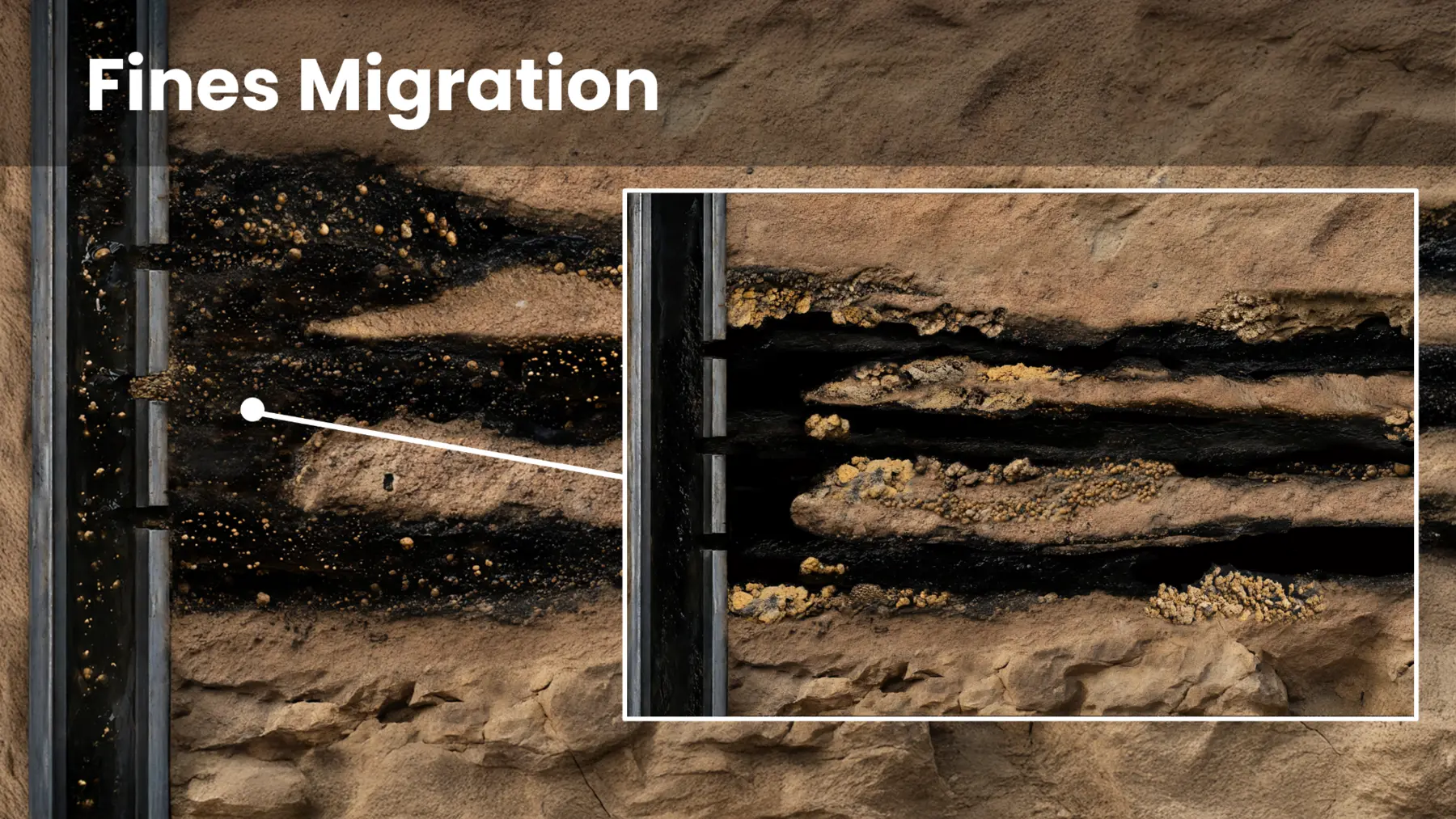
Water-like biogenic fluids can move through the pore network to reach the source of mobile fines and sand. Biomineralization then creates mineral bonds at grain-to-grain contacts, stabilizing the formation before particles migrate into pore throats, the wellbore or surface equipment.
Treatment intensity is designed around the formation and production objective so particles are bound without filling the entire pore network. The mineral response can also be reversed with acid when required.
Discuss this applicationWhere it fits
Designed around the connected pathway.
Every program begins with the treatment objective, available diagnostics, access geometry, injectivity and the performance signal that will define success.
- Fines migration
- Sand production
- Near-wellbore stabilization
- Formation strengthening
Related Department of War work
Soil and sand stabilization
The same mineral-bonding mechanism used to stabilize loose formation grains has been demonstrated at field scale in native beach sand. Under DARPA's SBIR XL program, BioSqueeze converted loose, saturated sand into a consolidated operating surface at Camp Lejeune.
See the defense demonstration →Related articles
The $10 Billion Problem That Starts in Your Pore Throats
There's a category of formation damage that every production engineer recognizes, most operators accept as a cost of doing business, and almost nobody has solved permanently… fines migration.
Read article →Is Your Well a Biomineralization Candidate?
A practical framework for selecting the right problem, well, baseline and success criteria for a measurable biomineralization field trial.
Read article →From Pilot to Program: How BioSqueeze Validates New Biomineralization Applications
A disciplined field-validation framework for extending BioSqueeze’s proven biomineralization platform into repeatable new commercial applications.
Read article →Evaluate a candidate