
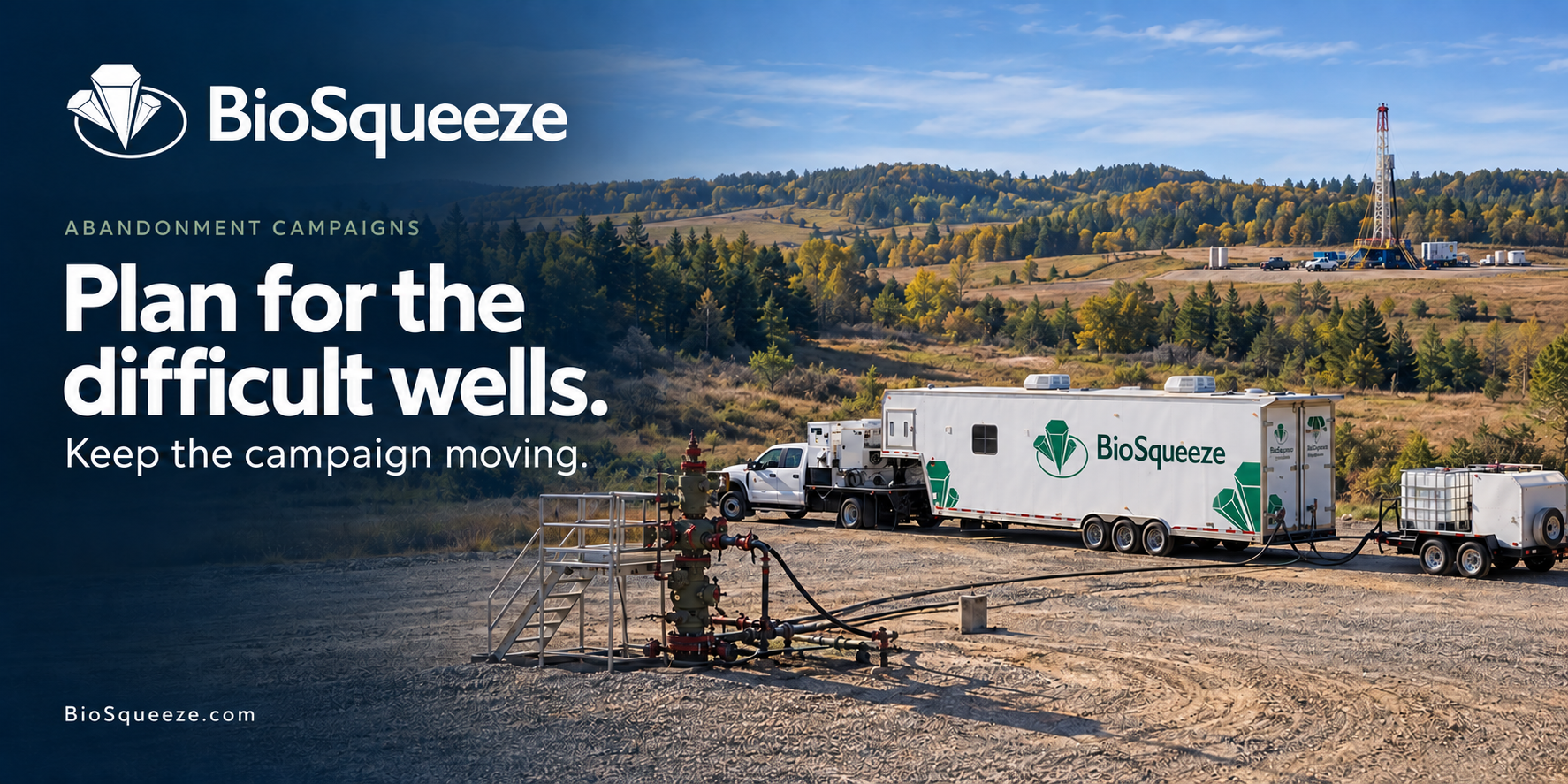
Persistent leaks can turn a routine plugging schedule into repeated remedial work. Planning those wells into a dedicated treatment sequence gives operators more control over access, verification, and the work that follows.
An abandonment campaign can look straightforward on the schedule. The wells are identified. The rig is booked. Crews know where they are going next.
Then one well will not stop flowing gas. Another still builds annular pressure after a cement squeeze. A third has already been plugged, but gas is reaching surface through a pathway the original work did not isolate.
The immediate problem belongs to an individual well. The consequences can extend across the program. A rig stays longer than expected, a specialist crew needs to return, or the next location waits while the team works out what to try next. If treatment and verification were never given their own place in the plan, the schedule absorbs both the remediation work and the decisions surrounding it.
These are the wells that deserve attention before the campaign is underway.
For operators planning plugging and abandonment, the opportunity is to identify persistent integrity problems early and build the appropriate remediation into the sequence. BioSqueeze can be part of that plan, addressing connected leakage pathways while the operator coordinates access preparation, treatment, testing, and the remaining abandonment work.
The result to pursue is clear: fewer unplanned returns to unresolved wells and a more deliberate use of the people and equipment already committed to the campaign.
Why a difficult well becomes a campaign problem
Most abandonment schedules contain dependencies. A crew cannot perform the next operation until the preceding work has established the required well condition. Equipment availability, location access, and testing arrangements influence when that work can happen.
A persistent leak introduces another dependency. Before the well can progress, the team needs an explanation for the flow, a way to reach the relevant pathway, and evidence that the selected treatment has achieved its objective. When those questions are addressed only after the rig arrives, engineering decisions compete with field execution for time.
Consider a well with a history of unsuccessful remedial work. Booking another intervention may be simple. Establishing whether it will reach a different interval, improve placement, or address a previously untreated annulus takes more investigation. Without that distinction, another mobilization can reproduce the same uncertainty.
The planning problem becomes larger when several wells share that history. Treating each as an exception creates a succession of separate decisions, even when the campaign could use a common approach to gathering data, arranging access, and defining verification.
Operators do not need identical wells to benefit from a coordinated process. They need visibility into which wells can follow the routine abandonment sequence and which require additional integrity work before the next operation can proceed. That distinction makes the schedule more useful than a list of locations and estimated rig days.
Diagnose the pathway before repeating the treatment
Pressure or flow at surface identifies a problem that needs investigation. It does not, by itself, provide a complete picture of the route that gas or fluid is taking.
The relevant information may be spread across the well schematic, cement records, logging interpretation, pressure and flow measurements, and reports from previous interventions. Bringing those records together helps the engineering team distinguish a placement problem from an access problem, and a localized defect from more complicated communication between annuli.
For a campaign, that review should answer several practical questions:
- Where has pressure or flow been observed, and under what test conditions?
- What do the construction history and available diagnostics indicate about possible communication paths?
- What was attempted previously, where was it placed, and what changed afterward?
- What access exists today, and what preparation would a new treatment require?
- What observation or test will determine whether the well is ready for the next operation?
A previous treatment report is particularly valuable when it explains the response rather than simply recording that the job was completed. An inability to establish injection means something different from successful placement followed by continued gas flow. A reduction in pressure is different from a demonstrated seal under the required test conditions.
Those distinctions influence the next intervention. They also help prevent a schedule from treating every unresolved well as if it needs the same equipment and the same duration of work.
The purpose of early review is to identify the information that changes the operating plan. If an additional diagnostic is needed, the team should know which decision it will support and arrange it before that missing information becomes a field delay.
Where biomineralization fits in the abandonment plan
Cement and mechanical barriers remain important tools in well abandonment. BioSqueeze addresses a particular challenge within that work: connected defects that can continue transmitting gas or fluid even when plugging material is already present.
Our low-viscosity treatment fluids can enter accessible leakage pathways and form calcium carbonate in place. As mineral accumulates within a connected channel, permeability decreases and subsequent fluid can divert into other connected paths. Treatment design is built around the available access and the specific integrity objective. How BioSqueeze technology works.
This placement capability is useful where another bulk-material treatment would struggle to enter the pathway that needs sealing. It does not remove the need to establish communication with the target or understand the well configuration. A treatment still needs a viable delivery route and a verification plan. BioSqueeze well-integrity applications.
Within an abandonment campaign, BioSqueeze can therefore be planned as a targeted remediation step alongside other required work. The objective may be eliminating annular flow before the well advances, treating a connected defect around an existing barrier, or addressing leakage that remains after previous plugging activity.
Successful remediation does not automatically mean the entire abandonment is complete. The operator still needs to execute the remaining barrier program and satisfy the applicable testing, documentation, and approval requirements.
Different wells reveal different planning constraints
BioSqueeze's abandonment work spans more than one well configuration or failure history. Three published examples illustrate why a campaign benefits from a consistent planning process without assuming that every well needs the same treatment.
Multiple annuli at an Appalachian storage well
At a storage well in Erie County, New York, the initial objective was to eliminate gas on an inner annulus. During treatment, bubbling on an outer annulus revealed a second connected problem. The work required additional access and a separate treatment sequence. Both annuli were sealed, sustained casing pressure was eliminated, and the well was approved for plugging and abandonment. Read the Appalachian storage case.
For planners, the lesson is to account for communication beyond the first observed flow path. The initial objective, the observations that could change it, and responsibility for additional preparation should be clear before the next crew is committed.
Unsuccessful cement squeezes in the Permian Basin
In Loving County, Texas, a well being permanently plugged had persistent annular gas and fluid flow. Multiple conventional squeeze attempts had failed to establish injection. The operator re-perforated to create treatment access, and staged BioSqueeze treatment eliminated the observed flow. Read the Permian abandonment case.
Here, the planning issue involved both access and material placement. The next intervention needed to change how treatment reached the connected pathway. Repeating an earlier job description would not have captured that requirement.
Leakage after plugging in the Eagle Ford
A DeWitt County, Texas, deployment involved a previously plugged well that continued leaking gas to surface. BioSqueeze was selected to address the active pathway with low-viscosity fluids and mineral formation in place. Read the Eagle Ford case.
This example separates two milestones that can be confused in a work program: placing plugging material and establishing that the relevant leakage pathway has been isolated. Planning needs to account for the second, including how the result will be checked.
These are individual examples, not a single campaign dataset or a prediction of what every well will require. Together, they show why the scope should follow the diagnosed problem rather than the last treatment attempted.
Give difficult wells an explicit place in the sequence
A useful campaign review separates wells by the work that must happen next. Some may be ready for routine abandonment operations. Others need an integrity treatment with access already available. A third group needs additional diagnosis or preparation before a treatment can be scheduled responsibly.
Those distinctions should be visible to the people arranging the field work. A well with unresolved access requirements should not look interchangeable with a prepared well simply because both appear on the same abandonment list.
For each well requiring remediation, the operating plan should identify the access condition needed for treatment, the crew responsible for creating it, and the information that confirms preparation is complete. It should also identify the intended verification and any subsequent operation that depends on that result.
This makes it possible to coordinate wells that are genuinely ready for similar work. Geographic proximity can help with mobilization, but proximity alone is not enough. Two nearby wells may require different access arrangements, pressure controls, or equipment. Conversely, wells with similar preparation requirements may offer a useful opportunity to organize specialist work together.
Sequencing should also reflect uncertainty. A well that may require another access point needs room for that decision. A location with limited seasonal access needs its treatment and follow-up work considered together. Moving an unresolved task to the end of a campaign does not make its dependencies disappear.
The objective is a sequence the field team can act on. Each well should have a clear next step, an owner for that step, and a defined condition for progressing. When new information changes the scope, the effect on the rest of the campaign should be visible rather than discovered through a missed handoff.
Make the handoff between crews explicit
Rig-assisted preparation and treatment do not always need to occupy the same continuous block of rig time. Where the engineered well configuration permits it, access can be established and the rig released before BioSqueeze treatment begins.
That separation has been demonstrated in BioSqueeze's San Juan disposal-well work: the workover unit moved to another well after preparing access, and treatment proceeded without it. That was an operating-well remediation, not an abandonment campaign, but it demonstrates a scheduling approach that can be evaluated where conditions allow. Read the San Juan case.
For abandonment planning, the important question is which activities actually require the rig to remain. The answer depends on the access arrangement, well-control requirements, subsequent operations, and the treatment design. A rig-reduced sequence should be engineered and agreed, not assumed from the technology name.
A clear handoff records the completed preparation, equipment left in place, relevant operating limits, and the arrangements for monitoring and intervention. The incoming team needs confirmation that the well is ready for its work. The outgoing team needs to know what would trigger a return and whether that return is already included in the plan.
Where separation is appropriate, the campaign can then coordinate treatment on prepared wells while the rig performs other required work. Any benefit depends on having productive work available for the released equipment and preserving the access needed to finish the original well. Moving a rig without planning the return work can simply shift the delay elsewhere.
Define verification before treatment starts
Treatment monitoring and final verification serve different purposes. Monitoring helps the team understand how the well is responding while work is underway. Verification establishes whether the intended outcome has been demonstrated sufficiently for the next decision.
A changing injection response can inform treatment execution. It should not be treated as a substitute for the agreed evidence that leakage or pressure communication has been addressed. Likewise, an observation of no flow only has meaning in the context of the measurement method and conditions under which it was made.
Before work begins, the operator and service team should agree on the baseline, the intended post-treatment observations or tests, and the record needed for review. The appropriate approach depends on the well and the abandonment program; one universal pressure, duration, or measurement method should not be assumed across every jurisdiction and configuration.
Plan the logistics of verification as carefully as the treatment itself. Identify who performs the measurements, who reviews the results, and whether any required equipment or personnel need a separate mobilization. Allow time for the result to be assessed before the next dependent operation is booked as ready.
The plan should also explain what happens if the result is incomplete or ambiguous. Additional diagnosis, further treatment, and revised access requirements have different implications for the schedule. Defining the decision process in advance helps the team respond to new information without improvising the entire sequence.
For campaign reporting, keep remediation completion and abandonment completion as separate statuses. A well can have its targeted leak resolved while still requiring plugging work, documentation, or approval. Maintaining that distinction gives management an accurate view of progress and the remaining workload.
Measure the cost of getting the well through the program
The quoted treatment price is one part of the commercial decision. A campaign also carries the cost of preparation, diagnostics, mobilization, equipment occupancy, verification, and any additional work required before the well can progress.
Those items should be compared on a consistent basis. A lower-priced intervention may still require more supporting work. A treatment that releases rig time only creates a scheduling benefit if that capacity can be used elsewhere. A plan that includes verification from the start should not be compared with one that leaves testing as an unpriced follow-up.
Operators can make the comparison practical by tracking the complete sequence for each remediation well: interventions attempted, field visits, rig time used for preparation versus treatment, and elapsed time between the agreed milestones. Recording why a well stopped progressing is as valuable as recording how long it took.
This creates a better basis for the next campaign. If delays repeatedly arise from missing diagnostics, the response is earlier data review. If wells wait for access preparation, the preparation schedule needs attention. If completed treatments wait for verification, testing capacity belongs in the execution plan.
Campaign integration should be judged against those actual constraints. It is a way to organize the work more effectively, not a blanket promise that every well will take fewer days or cost less.
Build remediation into the campaign before schedules are locked
Persistent integrity problems are easier to plan around when they are visible before crews arrive. Reviewing the well history, selecting the right access strategy, and arranging verification gives the operator a clearer basis for the work that follows.
BioSqueeze brings an established commercial well-integrity capability to that process. Our field experience across the United States and Canada includes difficult annular leakage and casing-integrity problems in different operating environments. The value of that experience extends beyond selecting a treatment fluid to understanding how the remediation can fit the larger program. Explore our oil-and-gas field experience.
For an abandonment campaign, the conversation should begin with the sequence of work across the portfolio: where unresolved leaks could interrupt progress, which wells need preparation, and where treatment and verification can be coordinated with the rig schedule.
Planning an abandonment or well-integrity campaign? Bring BioSqueeze into the operating plan before schedules are locked. Work with our team to coordinate diagnostics, access preparation, treatment, and verification across the program, with the goal of reducing unplanned remedial work and keeping rigs focused on the operations that require them.